How it works
The back to back drawing game needs two chairs, paper and one picture the drawer never sees. This page deals that picture from 60 original line drawings in three levels: simple things, busy scenes and abstract arrangements. For a simple back to back drawing activity, stay on the first level. Twelve pictures carry a read-aloud script, and 15 printable sheets cover rooms without phones.
Read the full guide
Deal a picture and play a round
Seat two players back to back. The describer holds the phone, the drawer holds paper and a pencil. A picture is on screen from the start, and the list under the button changes the level. The name and the notes stay under a cover. The describer talks the drawer through the picture with shapes, sizes and positions only: "a large square in the lower part of the page", never "a house". The white square around the picture stands for the edge of the drawer's paper. The picture is small on the screen, and a pinch zoom keeps its lines sharp. After two to four minutes, turn round and compare. Press Show notes, then Pick another picture, and swap roles. Some groups call it the blind back to back drawing game.
60 pictures for back to back drawing, in three levels
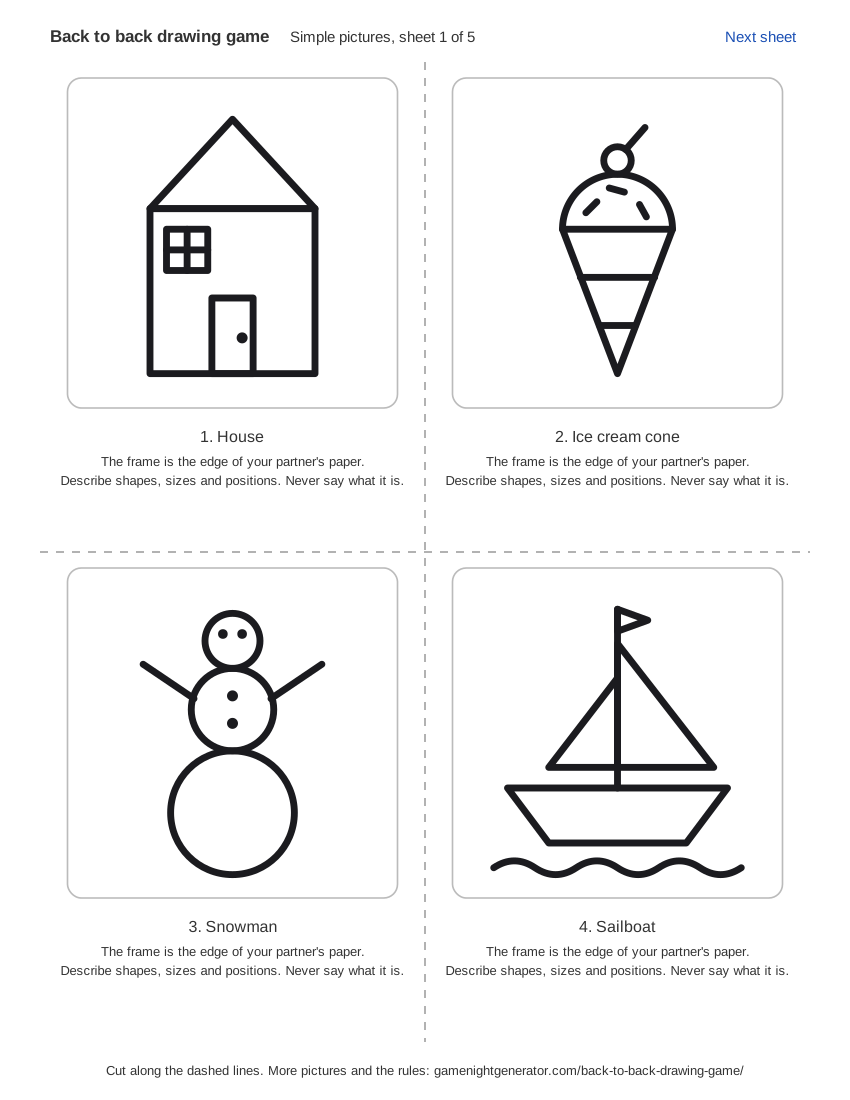
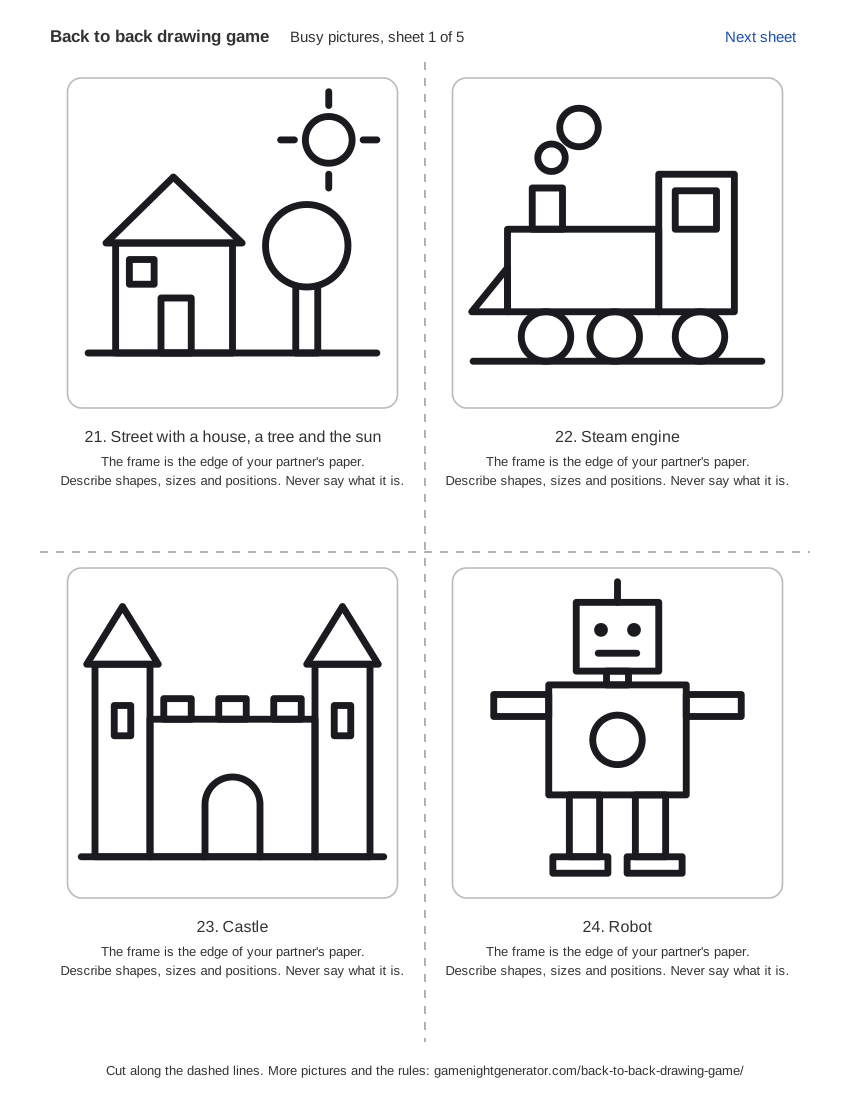
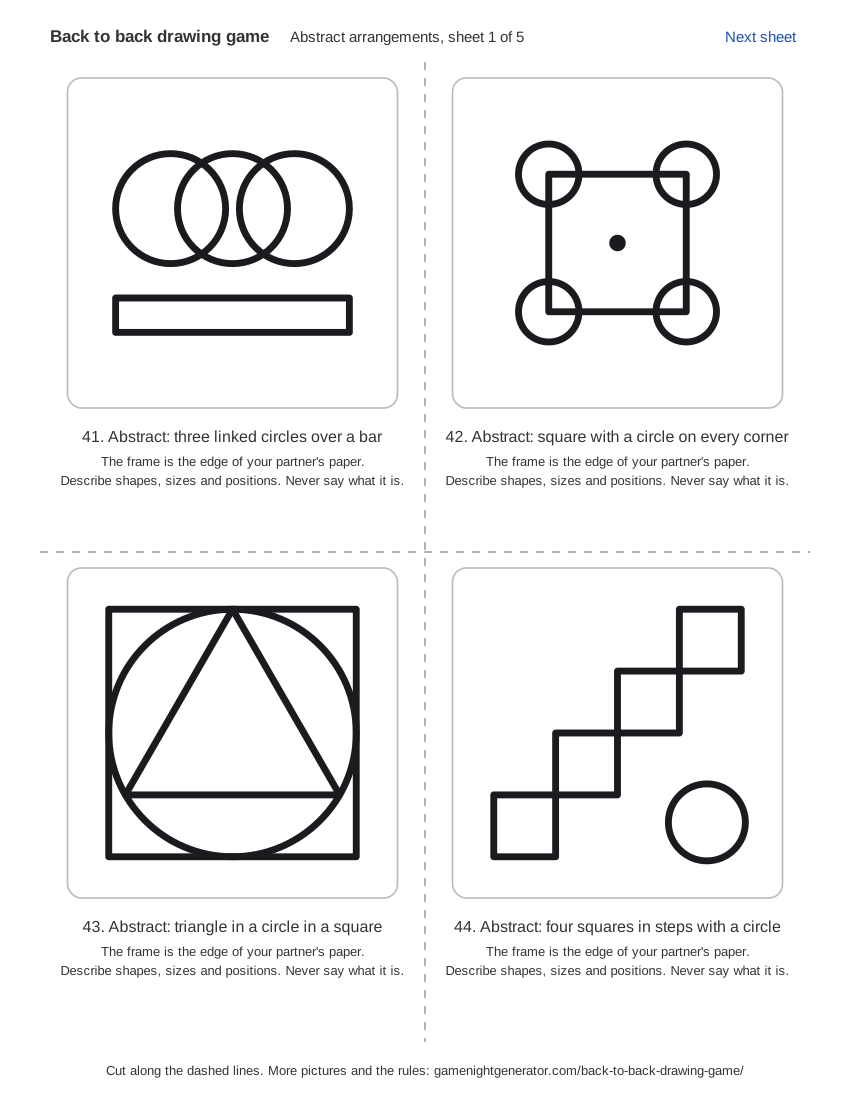
Simple pictures show one thing built from 3 to 10 lines and shapes: a house, a sailboat. Busy pictures use 7 to 15, and overlap starts to matter, as in a cat whose head covers the top of its body. Abstract arrangements have nothing to name, so the abstract images suit a back to back communication drawing activity, where "it looks like a rocket" would be a shortcut. After the round, Show notes opens a checklist of every shape and where it sits. For rooms without phones, open a sheet of four pictures, simple, busy or abstract, and print it. Each level has five sheets, and a link at the top of a sheet opens the next.
Run it as a listening drawing activity for a whole room
Twelve simple pictures carry a read-aloud script of six or seven plain directions. Press With a script here or under More filters, scroll up to the tool, deal a picture and open Show notes. Read one direction at a time, twice at most, while everyone draws on their own sheet. Nobody may ask anything in this listening and drawing activity, so it doubles as an active listening drawing exercise for a class or a team meeting. The scripts never name the object, so the room learns what it drew only when you show the picture on the big screen or as a printed card.
- Play three rounds with three rules: the drawer stays silent, then may ask yes-or-no questions, then both talk freely. The drawings usually get closer each time, and that contrast opens the debrief.
- Open every description with the overview: how many shapes, and which is the largest. Then work outward from it.
- In a communication exercise, drawing skill is beside the point. Say so before the first round.
- The page has no clock. Use a phone timer, or the one minute game timer.
Questions and answers
How do you play the back to back drawing game?
Two players sit back to back. One holds a picture and describes it with shapes, sizes and positions, never naming the thing. The other draws what they hear without seeing it. After two to four minutes they compare and swap roles. Any number of pairs can play at once, and children can join on the Simple level.
What should we ask after a back to back drawing team building activity?
Four questions cover it. Which words from the describer helped most? Where did the drawing go wrong, and which instruction caused it? What did the drawer want to ask and could not? What will each of you do differently in the next handover at work? The back to back drawing communication exercise earns its time in that talk, so give it as long as the drawing.
Is there a back to back drawing team building PDF?
There are 15 printable sheets and no PDF file. Open a sheet, choose Print, and pick Save as PDF as the printer. Each sheet holds four pictures with cut lines and scales to Letter or A4 paper. The Print button in the tool prints the picture at its small screen size, so use the sheets for paper.
What does this drawing activity for communication show a team?
As a communication drawing activity it makes a gap visible: what one person means and what another hears. Words such as "big", "next to" and "in the corner" turn out to be vague, and the silent round shows what is lost when a listener cannot check. No claim is made that the exercise has been tested or measured.