Bingo Patterns: 64 Pictured Shapes and What Each One Takes
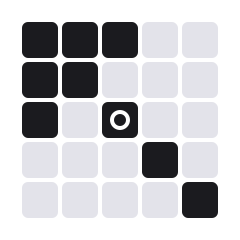
Crazy L (roving L)An L turned any of 4 ways: the B or the O column, joined to the top or the bottom row. 9 numbers every time.
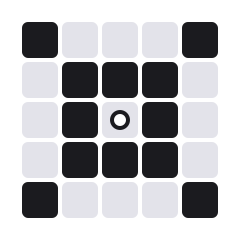
Bunny earsTwo ears at I1 and G1, then the B, N and O columns from the second row down: 13 numbers plus the free center.
Easter crossThe N column with the whole second row as the crossbar: 8 numbers, since the upright passes through the free center.
Five around the cornerA corner square and the two squares that follow it along each edge: 5 numbers, and any of the 4 corners will do.
ArrowAn arrowhead packed into one corner, with a shaft along the diagonal through the free center to the far corner: 8 numbers, and it can point at any of the 4 corners. One pattern book draws its arrow straight up instead, on the Christmas tree squares.
SputnikThe small picture frame plus the four corners: 12 numbers. Also listed as a butterfly.
Double bingo (any two lines)Two complete lines on one card, 66 possible pairs. A pair takes 8, 9 or 10 numbers, depending on whether the two lines cross and whether one of them runs through the free center.
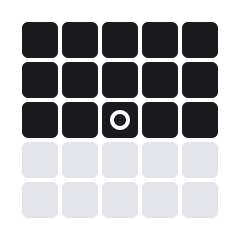
Top half or bottom halfThree full rows: the top three or the bottom three. Either way the middle row is included, so it is 14 numbers plus the free center. 2 ways.
Bingo Patterns: 64 Pictured Shapes and What Each One Takes: how it works
Bingo patterns decide how long each game runs and how hard it is to check. This page holds 64 of them in seven groups, from four corners and the postage stamp to the Indian star and cover-all. Each has a small picture of the card, the squares it covers, how many numbers it takes and whether the free center helps. Deal a program, then print it.
Deal a night's program from one phone
The page opens on eight patterns, each beside a small picture of the card: dark squares are the ones to cover, and the ring marks the free center. The line under the name says which squares count and how many numbers that takes. Press 5, 10 or 12 for a shorter or longer night. The chips narrow the deal to one group, such as Lines or Letters, and All mixes them. Lock the rows you like and press New patterns, or Swap the odd one out. A program that climbs works well: any line or 4 corners bingo to open, a shape in the middle, and cover-all last.
How to read a pattern, and where halls differ
Squares are named by column letter and row from the top, so B1 is the top left corner and N3 is the free center, which counts as covered whenever a pattern uses it. That is why the letter X bingo pattern takes 8 numbers, not 9. The hardway bingo pattern is the opposite idea: a straight line that misses the center, so all 5 numbers must be called. Small picture frame bingo is the 8 squares round the center. Crazy means the shape may be turned, so crazy T bingo and crazy kite bingo each win 4 ways. Names are not standard: one book's ladder is another's large ladder, and the arrow has several drawings. Rules vary, so show the picture before the first call.
Print the program, and what the phone remembers
Print puts the page heading and the patterns on screen onto one sheet in two columns, each with its picture and its line, so the caller can tick games off. Copy all takes the pattern names as text, and Share makes a link that opens the same patterns on another phone. The heart on a row keeps that pattern on your Saved page, on this phone only. No pattern comes up twice until you have seen all 64. The address keeps your group, so the seasonal patterns can be bookmarked. The full list lower down describes every pattern in words.
Tips
Hold up the printed picture when you announce a game. A shape is quicker to check than a name.
For winter bingo patterns, press Seasonal and lock the Christmas tree, bell and candy cane. The Indian star doubles as a snowflake.
More ways to win means a shorter game: any line has 12 ways, and a fixed shape has one.
With kids, stay on Lines and Letters. A shape they can name is a shape they can check for themselves.
Say out loud whether the free center counts. In a hardway game it never does.
Questions and answers
What is a postage stamp in bingo?
A block of four squares, two by two, in a corner of the card. The postage stamp bingo pattern is usually drawn in the top right, where a stamp goes on an envelope: G1, O1, G2 and O2. Many halls play postage stamp bingo in any of the four corners, which gives 4 ways to win, and a double postage stamp asks for two corners on one card. Rules vary, so say which before you start.
What is the hardway bingo pattern?
A straight line made without the free center. That rules out the middle row, the N column and both diagonals, and leaves 4 rows and 4 columns: 8 ways, each needing all 5 numbers. Double hardway bingo asks for two such lines on one card, which takes 9 numbers when a row crosses a column and 10 when the two lines run the same way.
How many numbers does each pattern take?
The line under every pattern says. 4 corners bingo takes 4 numbers. Lucky 7 bingo and the diamond bingo pattern take 8 each, the Indian star bingo pattern takes 16 round the free center, and coverall bingo takes all 24. Picture frame bingo comes in two sizes: 8 numbers for the small frame and 16 for the large one.
Do these patterns work with the bingo cards on this site?
The shapes do. Cards from the bingo card generator are 5 by 5 with a free center, so every pattern fits them, and the bingo flashboard calls the numbers. Those cards do not keep numbers in lettered columns, though. A note such as "only B and O numbers help" applies to a standard card headed B, I, N, G, O.
Any line (regular bingo)Five in a row across, down or corner to corner: 12 ways. The middle row, the N column and both diagonals run through the free center, so those four need only 4 numbers.
Double bingo (any two lines)Two complete lines on one card, 66 possible pairs. A pair takes 8, 9 or 10 numbers, depending on whether the two lines cross and whether one of them runs through the free center.
Double hardwayTwo hardway lines on one card, so the free center never helps: 28 pairs. A row and a column share a square and take 9 numbers. Two rows, or two columns, take 10.
Hardway bingoA straight line that misses the free center, so all 5 numbers are called. That leaves 4 rows and 4 columns, 8 ways. The middle row, the N column and the diagonals do not count.
LadderThe I and G columns are the rails, and N2 and N4 are the rungs: 12 numbers. No B or O number is needed.
Large ladderThe ladder at full width: the B and O columns for rails and the whole second and fourth rows for rungs, 16 numbers. One pattern book calls this one simply the ladder.
Layer cakeThe top, middle and bottom rows: 14 numbers plus the free center. Also listed as a sandwich.
Railroad tracksTwo rails: the whole I column and the whole G column, 10 numbers. No B, N or O number is needed. One pattern book gives the name to any two lines that lie side by side, which makes 8 ways.
Tic tac toe (hashtag)The I and G columns crossed by the second and fourth rows, like a tic tac toe board: 16 numbers. Also listed as a hashtag or number sign.
Triple bingo (any three lines)Three complete lines on one card, in any of 220 combinations. Lines may cross, and a line through the free center is one number cheaper.
Corners and stamps 8
Block of four (anywhere)A two by two block anywhere on the card: 16 places. The four blocks that touch the free center need only 3 numbers. One pattern library calls this floating block the postage stamp.
Block of nine (nine pack)A three by three block anywhere: 9 places. Every one of them covers the free center, so it is always 8 numbers.
Double postage stampTwo corner stamps on one card: 8 numbers, 6 possible pairs of corners, and no N number is needed. One published guide joins two opposite stamps at the free center and calls that a bow tie.
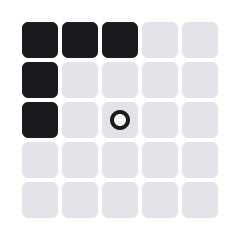
Five around the cornerA corner square and the two squares that follow it along each edge: 5 numbers, and any of the 4 corners will do.
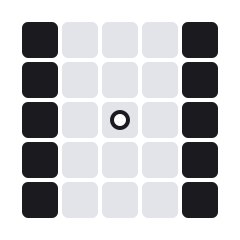
Four cornersThe top and bottom squares of the B column and of the O column: 4 numbers. On a standard card only B and O numbers can help anybody.
Four postage stampsA stamp in every corner: 16 numbers, and no N number is needed. With the free center added it is also listed as a clover leaf or a windmill.
Postage stampA block of 4, two by two, tucked into a corner. The classic spot is the top right, where a stamp goes on a letter (G1, O1, G2, O2), but many programs take any of the four corners.
Six packA block of 6, two by three, lying down or standing up, anywhere: 24 places. A block over the free center needs 5 numbers. A hardway six pack bans the center and leaves 12 places.
Picture frames 5
Broken frameA large picture frame with any one square left open: 15 of the 16 edge squares, 16 ways. Also listed as a missing link.
Cross and frameThe large picture frame with a plus sign inside it: 20 numbers and the free center. Only I2, G2, I4 and G4 stay open.
Large picture frame (outside frame)All 16 squares round the edge: the whole B and O columns plus the top and bottom of I, N and G. The free center is no help. Also listed as an outside edge or outer border.
Letter X and frameThe large picture frame with a letter X inside it: 20 numbers and the free center. Only N2, I3, G3 and N4 stay open.
Small picture frame (inside frame)The 8 squares that ring the free center. Only I, N and G matter, and from N only N2 and N4, so no B or O number is needed. Also listed as an inner frame or around the free.
Letters 14
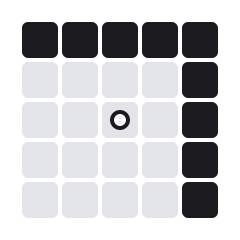
Crazy L (roving L)An L turned any of 4 ways: the B or the O column, joined to the top or the bottom row. 9 numbers every time.
Crazy TA letter T turned any of 4 ways: one edge line for the bar, and the middle line running away from it for the stem. Always 8 numbers, since the stem crosses the free center.
Letter AA point at N1, shoulders at I2 and G2, the whole middle row for a crossbar, and legs down B and O: 11 numbers plus the free center.
Letter EThe B column with the top, middle and bottom rows running off it: 16 numbers plus the free center.
Letter HThe B and O columns joined by the middle row: 12 numbers. No N number is needed, because the crossbar meets the N column at the free center.
Letter IThe top row, the bottom row and the N column between them: 12 numbers. Turn the card a quarter and the same squares make the letter H.
Letter LThe B column and the bottom row: 9 numbers, and the free center is no help.
Letter NThe B and O columns joined by the diagonal from top left to bottom right: 12 numbers. Oddly, no N number is needed.
Letter O (zero)The large frame with its four corners cut off: 12 numbers. Also listed as a zero.
Letter TThe top row and the N column: 8 numbers, because the stem passes through the free center.
Letter VDown the B and O columns for three squares, then in through I4 and G4 to a point at N5: 9 numbers.
Letter XBoth diagonals: 8 numbers, crossing at the free center. No N number is needed, because the only N square in the X is the free one.
Letter ZThe top row, the bottom row and the diagonal from top right to bottom left: 12 numbers plus the free center.
Plus sign (cross)The N column and the middle row: 8 numbers, crossing at the free center.
Shapes 16
AirplaneFlying right: the middle row is the body, the whole G column is the wings, and B2 and B4 make the tail. 10 numbers plus the free center.
ArrowAn arrowhead packed into one corner, with a shaft along the diagonal through the free center to the far corner: 8 numbers, and it can point at any of the 4 corners. One pattern book draws its arrow straight up instead, on the Christmas tree squares.
Bow tieTwo triangles tip to tip: the whole B and O columns, the middle three squares of I and G, and the free center for the knot. 16 numbers, and no N number is needed.
CactusThe N column is the trunk, the middle row is the arms, and B and O each rise two squares to the top: 12 numbers plus the free center.
Crazy kiteThe kite flown from any corner: a corner stamp, and a tail along the diagonal to the opposite corner. 4 ways, 6 numbers each, and no N number is needed.
DiamondEight squares in a diamond outline: N1, I2, G2, B3, O3, I4, G4 and N5. Every column is called and the free center is no help. Also listed as a hollow diamond.
Full diamondThe diamond filled in: 12 numbers round the free center, which is every square except the four corner triangles. Also listed as a filled diamond.
Indian star (starburst)A letter X laid over a plus sign: 16 numbers round the free center. Also listed as a starburst, and one pattern library ends a snowflake game on the same squares.
KiteA corner stamp with a tail: the two by two block in the top left, then the diagonal through the free center down to O5. 6 numbers, and no N number is needed.
Large kite (giant kite)A three by three block in one corner with a two-square tail to the opposite corner: 10 numbers, since the block covers the free center. Played crazy, it flies from any of the 4 corners.
Lucky sevenThe top row, then the diagonal from O1 down through the free center to B5: 8 numbers in the shape of a 7. Also listed as number 7.
PyramidThe bottom row, the middle three squares of the row above, and the free center for the peak: 8 numbers. A crazy pyramid may stand on any of the 4 edges.
Small diamond (inside diamond)The 4 squares that touch the sides of the free center: N2, I3, G3 and N4. No B or O number is needed. Two published programs add the four corners to make an 8-number game.
SputnikThe small picture frame plus the four corners: 12 numbers. Also listed as a butterfly.
Top hatThe bottom row is the brim and the three by three block above it is the crown: 13 numbers plus the free center.
TurtleA head at N1, the whole second row for the front legs, a three-wide shell below it, and back feet at B5 and O5: 13 numbers plus the free center.
Seasonal 7
BellN1 on top, two rows of three, the whole fourth row for the rim, and N5 for the clapper: 12 numbers plus the free center. Some programs call the same squares a tree.
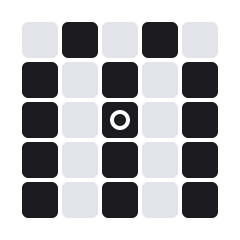
Bunny earsTwo ears at I1 and G1, then the B, N and O columns from the second row down: 13 numbers plus the free center.
Candy caneA stick down the G column with the hook over N1, I1 and I2: 8 numbers, no B and no O. Drawings differ from program to program. Another published cane runs down N and hooks left to B2.
Christmas treeA point at N1, three squares under it, the whole middle row for the lowest branches, and N4 and N5 for the trunk: 10 numbers plus the free center.
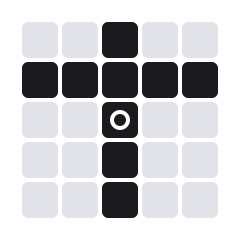
Easter crossThe N column with the whole second row as the crossbar: 8 numbers, since the upright passes through the free center.
HeartA heart in outline: bumps at I1 and G1, a dip at N2, sides down B and O, and a point at N5. 10 numbers, with the free center left open. Some programs fill the heart in.
Witch hatA tall point down N1 and N2, two rows of three for the crown, and the whole bottom row for the brim: 12 numbers plus the free center.
Cover-all and big finishes 4
CheckerboardEvery other square, starting from the corners: 12 numbers plus the free center, spread over all five columns.
Cover-all (blackout)Every square on the card: 24 numbers plus the free center. Also called a blackout or a full house. No pattern takes more numbers, so it suits the last game of the night.
HighwayThe whole B, I, G and O columns with the N column left open down the middle: 20 numbers, and no N number is needed.
Top half or bottom halfThree full rows: the top three or the bottom three. Either way the middle row is included, so it is 14 numbers plus the free center. 2 ways.
How this list was compiled: Every pattern here was checked on 2026-09-19 against at least two separately published sets of bingo patterns, square by square: the Game Patterns book from Arrow International (https://info.arrowinternational.com/hubfs/assets/arrowinternational.com/resources/bingo-knowledge/pdf/GamePattern.pdf), the pattern library at https://letsplaybingo.io/patterns and the pattern guide at https://www.bingocardcreator.com/blog/bingo-patterns. The straight line, hard-way line, four corners, postage stamp, roving L, diamond and cover-all were also checked against https://en.wikipedia.org/wiki/Bingo_(American_version) and https://en.wikipedia.org/wiki/Bingo_card. Where two sources give one name to different squares, the line under the pattern says so. The candy cane is the one pattern whose two published drawings do not match, and its line says that too. Patterns found in only one source were left out. The counts of squares, numbers and ways were worked out from the 5 by 5 card for this page, and the pictures and descriptions are our own. Names and shapes vary from hall to hall, so the drawing on your own program is the one that counts. Licence: own work